

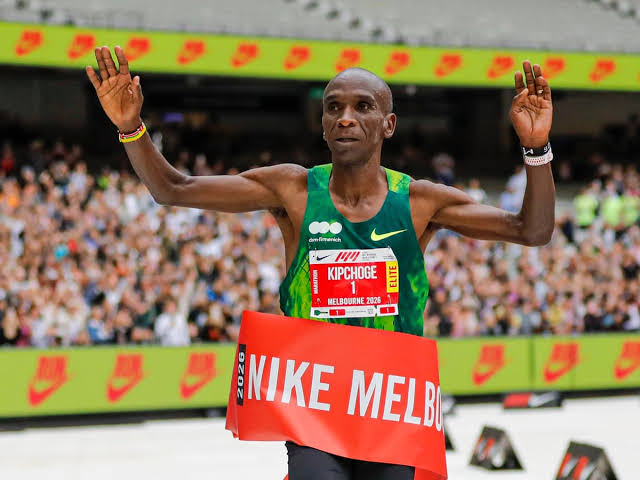

At 41, when many elite distance runners have stepped away from the demands of competitive marathon racing, Eliud Kipchoge is proving that his name still commands respect on the global stage. The Kenyan marathon legend has returned to the winner’s circle with a course-record performance in Melbourne, reminding critics that his remarkable career is far from over.
Kipchoge clocked 2:09:10 to win the 2026 Melbourne Marathon setting a new course record and securing his first marathon victory in three years. The two-time Olympic champion delivered a commanding performance, pulling away from his challengers in the final 10 kilometres before crossing the finish line to the cheers of spectators.
The victory was particularly significant for the veteran runner, whose career has been defined by extraordinary consistency, Olympic success and landmark achievements over the marathon distance. His Melbourne triumph marked his 17th career marathon victory, adding another accomplishment to an already decorated record.
Kipchoge finished ahead of Australian runners Thomas Do Canto and Reece Edwards, who also featured among the leading finishers. His winning time underlined his ability to maintain a competitive pace over the gruelling 42.195-kilometre distance, where endurance, tactical judgment and mental strength can determine the outcome.
The Melbourne race also offered Kipchoge an opportunity to demonstrate that experience remains a valuable asset in a sport increasingly associated with younger athletes pushing the limits of speed and performance. Rather than relying solely on his reputation, he delivered a result on the course, producing the fastest winning time in the event’s history.
His latest achievement comes as part of a broader ambition to promote running internationally. Kipchoge has continued to use his status to encourage participation in the sport and inspire runners beyond Kenya, where marathon running has become an important part of the country’s international sporting identity.
Kenya has produced generations of world-class distance runners, with athletes earning international recognition through Olympic medals, world championships and major marathon victories. Kipchoge stands among the most celebrated figures of that tradition, having helped elevate the profile of Kenyan athletics across the world.
His legacy extends beyond winning races. Kipchoge famously became the first person to run a marathon in under two hours during the INEOS 1:59 Challenge in Vienna in 2019, finishing in 1:59:40. Although the specially organised event did not qualify as an official world record, it became one of the most significant demonstrations of human endurance in modern athletics.
The Melbourne result adds a new chapter to that legacy, particularly because it came after a three-year wait for another marathon victory. It also demonstrates the competitive demands of the sport, where previous achievements cannot guarantee success against a field of determined opponents.
For Kenyan athletics, Kipchoge’s victory is another source of pride and a reminder of the country’s continued influence in international distance running. His performance in Australia has reinforced his standing as one of the sport’s enduring figures, even as he enters a different stage of his career.
At an age when the physical demands of marathon racing can become increasingly difficult to manage, Kipchoge has shown that experience, discipline and tactical execution can still deliver results at the highest level.
His Melbourne triumph may not erase the challenges that come with ageing in elite sport, but it has provided a compelling answer to anyone who assumed his best days were necessarily behind him.