
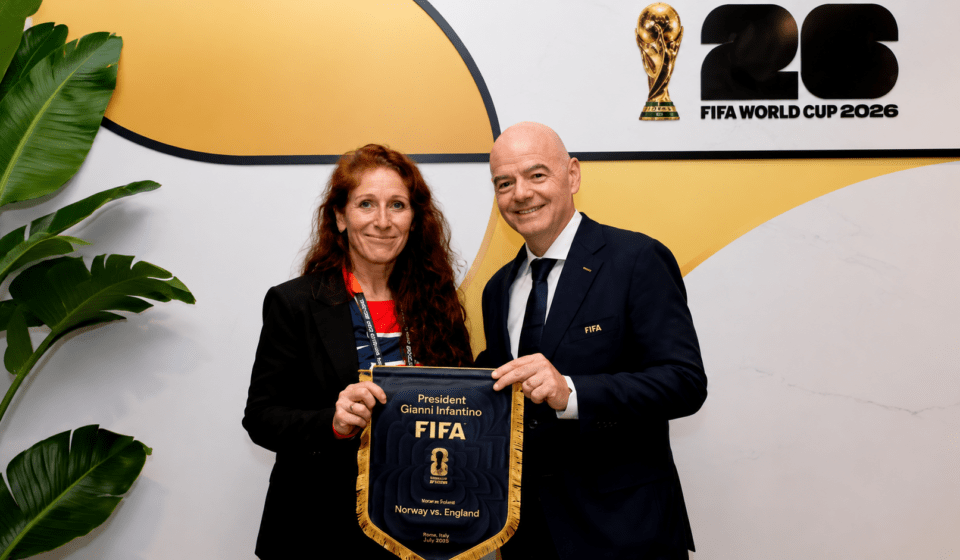

FIFA President Gianni Infantino is facing his most serious leadership challenge since taking office in 2016 after Norway called for his resignation, while Mexico, Argentina and the Confederation of African Football rallied behind him in a widening dispute over governance at world football’s governing body.
The confrontation follows FIFA’s decision to abandon a controversial plan to raise about $4.2 billion by selling a stake in the commercial rights to future World Cup and other tournament revenues.
The proposal angered several European associations and regional confederations, which said they had not been properly consulted.Norwegian Football Federation
President Lise Klaveness said Infantino had lost the institutional confidence necessary to lead FIFA President Gianni Infantino is facing his most serious leadership challenge since taking office in 2016 after Norway called for his resignation, while Mexico, Argentina and the Confederation of African Football rallied behind him in a widening dispute over governance at world football’s governing body.
The confrontation follows FIFA’s decision to abandon a controversial plan to raise about $4.2 billion by selling a stake in the commercial rights to future World Cup and other tournament revenues. The proposal angered several European associations and regional confederations, which said they had not been properly consulted.
Norwegian Football Federation President Lise Klaveness said Infantino had lost the institutional confidence necessary to lead FIFA.
He does not have the institutional trust required to govern FIFA stably in the times we are in. There is no going back for Gianni Infantino,” Klaveness told reporters after the Norwegian federation’s board meeting on Friday.
She said the crisis had become bigger than the abandoned commercial proposal and called for a change in FIFA’s approach to governance
It’s very divided, very polarised. It’s a crisis, really. And then we need a leader to gather this and he’s not in a position to gather it now. So for the sake of football, we ask him to resign,” she added.
Klaveness said Norway hoped other European countries would eventually support its position. She also said football needed to move beyond what she described as “Game of Thrones” power struggles and concentrate on governance reform.
The Norwegian FA has raised several other concerns about FIFA during Klaveness’ tenure, including the awarding of tournaments, FIFA’s inaugural peace prize awarded to U.S. President Donald Trump and the overturning of a disciplinary ban involving American forward Folarin Balogun after a call from Trump.
𝑰𝒏𝒇𝒂𝒏𝒕𝒊𝒏𝒐’𝒔 𝒅𝒆𝒇𝒆𝒏𝒄𝒆
Infantino has not accepted that the controversy represents a failure of FIFA’s governance.
When the commercial proposal was first announced, he described it as an opportunity rather than an obligation, saying it was intended to unlock commercial value that FIFA was not currently capturing.
It’s part of a democratic process – a consultation process – and, above all, it is an opportunity but not an obligation,” Infantino said in video remarks provided by FIFA. He added that the World Cup would remain under FIFA’s control and without external interference
After the proposal was withdrawn, FIFA apologised to its 211 member associations for mistakes in how the plan had been handled. Following a crisis meeting in Morocco, FIFA’s leadership reaffirmed its support for Infantino and promised to review the process.
FIFA said the actions surrounding the commercial-rights proposal complied with its regulations and that the problems concerned process and communication rather than breaches of governance rules.
𝑴𝒆𝒙𝒊𝒄𝒐 𝒂𝒏𝒅 𝑨𝒓𝒈𝒆𝒏𝒕𝒊𝒏𝒂 𝒃𝒂𝒄𝒌 𝑰𝒏𝒇𝒂𝒏𝒕𝒊𝒏𝒐
While European opposition has intensified, Infantino continues to command substantial support elsewhere.
Mexico’s Football Federation publicly backed him, despite its regional confederation CONCACAF having called for a “comprehensive reckoning” with his presidency.
The FMF supports President Infantino’s leadership in continuing to promote the development of football through institutional strengthening,” Mexico’s federation said.
Mexico also rejected any attempt to remove Infantino outside FIFA’s formal institutional process, saying any such move must involve all 211 member associations.
Argentina’s football association also backed FIFA’s work over the past decade, praising its emphasis on global development and transparent governance.
The AFA acknowledged that the abandoned commercial proposal had created “far more uncertainties than certainties” and that mistakes had been made, but said the way forward was to continue working under FIFA’s leadership ahead of next year’s FIFA Congress.
Paraguay also reaffirmed its commitment to working with FIFA, while Ecuador’s football federation president Francisco Egas Lareategui credited FIFA support with the country’s “exponential development.”
We trust that you and those currently leading world football will continue working for the benefit of our sport, adhering to the rules with transparency and conviction,” Egas wrote to Infantino.
The Confederation of African Football has also given Infantino unanimous backing, strengthening his position outside Europe.
𝑬𝒖𝒓𝒐𝒑𝒆 𝒓𝒆𝒎𝒂𝒊𝒏𝒔 𝒐𝒑𝒑𝒐𝒔𝒆𝒅
The European resistance, however, has not disappeared following FIFA’s withdrawal of the proposal.
UEFA has threatened to boycott FIFA events and said it wants assurances that similar attempts to reshape the sport will not happen again.
UEFA said it remained committed to the boycott until it received guarantees that “such attempts to disfigure the game in this way will never be made again.”
CONMEBOL, South America’s governing body, has also criticised FIFA’s approach, expressing concern about “repeated unilateral actions taken without resorting to dialogue.”
The Asian Football Confederation said it “stood in solidarity” with UEFA and CONCACAF, although several of its members, including Qatar, Indonesia and the Philippines, have backed Infantino.
The players’ union FIFPRO has been even more critical, describing the abandoned proposal as a “profound abuse of presidential power.”
Canadian Prime Minister Mark Carney has also said he lost confidence in Infantino over the handling of the proposal.
“I don’t have confidence in Mr. Infantino,” Carney told reporters, arguing that failing to inform senior executives and fellow board members about such a major proposal “should be fatal” for a leader.
𝑩𝒂𝒕𝒕𝒍𝒆 𝒂𝒉𝒆𝒂𝒅 𝒐𝒇 2027 𝒆𝒍𝒆𝒄𝒕𝒊𝒐𝒏
The dispute now threatens to overshadow Infantino’s bid for a fourth term at the FIFA Congress in Morocco in March 2027.
A few European federations have withdrawn their backing, while supporters in Africa, Asia and Latin America continue to defend his leadership. No clear candidate has yet emerged to challenge Infantino.
The FIFA president therefore enters the next phase of the crisis with his political position weakened in Europe but still supported by influential football bodies across other regions.
For Klaveness, however, the argument is ultimately not about replacing one person with another.
Regardless of who will be re-elected or elected, it needs to be about real implementation of governance reforms now,” she said. “It needs to be about lasting change, where the checks and balances also works.”
She said FIFA’s future should be centred on governing football rather than competing commercially with its continental confederation
The competing positions leave FIFA facing a prolonged political battle: European critics are demanding structural change and questioning Infantino’s leadership, while a powerful bloc of national associations and confederations continues to argue that he should remain in charge.
There is no going back for Gianni Infantino,” Klaveness told reporters after the Norwegian federation’s board meeting on Friday.She said the crisis had become bigger than the abandoned commercial proposal and called for a change in FIFA’s approach to governance.”The international football cooperation is very much in trouble, and we must have a reason to get together now, and we want to ask the FIFA president to resign now,” she said.
Klaveness said Norway hoped other European countries would eventually support its position. She also said football needed to move beyond what she described as “Game of Thrones” power struggles and concentrate on governance reform.