
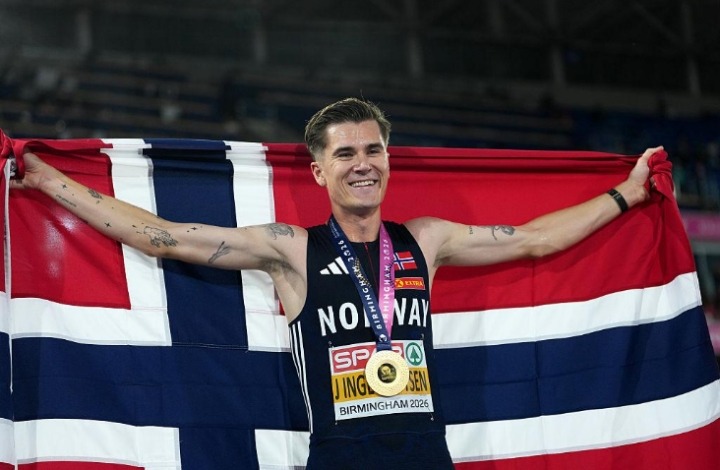

Norwegian Olympic champion Jakob Ingebrigtsen produced a remarkable comeback on Monday, winning the men’s 5,000 metres at the European Athletics Championships in Birmingham to claim his first race victory in nearly a year.
Ingebrigtsen clocked 13 minutes and 15.29 seconds to retain his European title, narrowly beating Germany’s Florian Bremm, who finished in 13:15.60.
France’s Etienne Daguinos took bronze in 13:16.09.
The victory was especially significant because Ingebrigtsen had undergone surgery on his left Achilles in February and had only six weeks of decent training before competing in Birmingham.
His previous race had ended in disappointment when he finished 10th at last year’s World Championships in Tokyo.
Despite those doubts, the 25-year-old Norwegian produced a composed performance before delivering a decisive sprint in the closing stages.
Ingebrigtsen began cautiously, settling into the middle of the pack as the runners went through the opening kilometre in a relatively slow 2 minutes and 45 seconds.
Rather than immediately moving to the front, he bided his time and conserved his energy.
With about four laps remaining, he began gradually moving up around the outside of the field.
However, his progress was briefly restricted at the start of the penultimate lap when he found himself behind Frenchman Jimmy Gressier.
Ingebrigtsen then accelerated at the crucial moment.
As the race entered its final stages, the Norwegian moved around Bremm on the outside and produced a powerful surge.
He sprinted down the final straight, pulling clear enough to secure the victory as the Birmingham crowd cheered him across the finish line.
The win marked Ingebrigtsen’s seventh individual European gold medal and extended his record as the most successful male athlete in the history of the continental championships.
It also preserved an extraordinary record: Ingebrigtsen has never lost an individual race at the European Championships.
The significance of the victory was not lost on Ingebrigtsen himself.
Speaking after the race, he acknowledged the uncertainty and self-doubt that had accompanied his return from injury.
I doubted myself every day coming in to this and every minute leading up to the last lap today, but I’m always hoping to do my best,” Ingebrigtsen said.
Ingebrigtsen described the achievement as particularly meaningful given how difficult the previous period had been.
Coming from the lowest of lows to be European champion again means the world to me. Not even I believed it could happen coming here. Only with 600 metres to go, I knew I would win,” He explained.
Ingebrigtsen’s comments underlined just how unexpected the result was; after surgery and a limited period of training, even the defending champion was uncertain about how he would perform when the race reached its decisive stages.
But once the final lap arrived, those doubts disappeared.
Ingebrigtsen’s acceleration proved too much for Bremm, who could not stay with the Norwegian once he moved ahead. Daguinos, who finished third, praised Ingebrigtsen’s performance and said the result demonstrated the Norwegian’s exceptional status in the sport.
When Jakob went in front I knew I couldn’t stay with him. He’s a legend of our sport. We knew if he’s here tonight it was because he is in good shape. He’s so strong. He showed that tonight,” Daguinos said.
The French bronze medallist also expressed his pride at sharing the podium with the Norwegian.
I am so proud to share a podium with him,” Daguinos added.
For Ingebrigtsen, the victory represented a dramatic turnaround from his last major championship race in Tokyo, where he endured what Reuters described as a humbling 10th-place finish.
His return to competition in Birmingham therefore carried considerable uncertainty.
With only six weeks of solid training following Achilles surgery, the Norwegian faced long odds of immediately returning to championship-winning form.
Instead, he produced a performance built around patience and a perfectly timed finish.The slow opening pace allowed him to remain in the pack without spending unnecessary energy.
He gradually improved his position as the race developed, then waited until the final stages to make his decisive move.
When he finally accelerated, Bremm could not respond.The victory not only gave Ingebrigtsen another European title but also reinforced his remarkable record at the continental championships.
His seventh individual European gold further extended his position as the most successful male athlete in the history of the championships.
After nearly a year away from racing and months of uncertainty following surgery, Ingebrigtsen had returned to the European stage and once again finished at the top.
His performance in Birmingham was therefore a major comeback victory for the Norwegian, who had entered the race with doubts about his own condition but left the stadium with another European gold medal and his unbeaten individual European Championships record intact.