

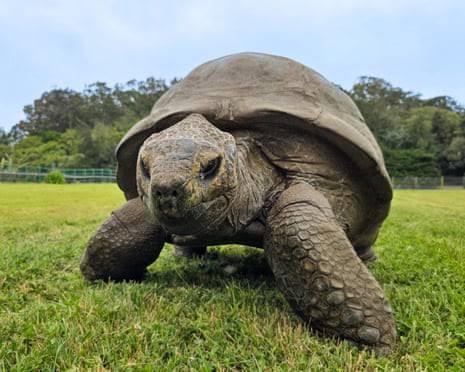

What if the secret to living longer has been hiding inside a tortoise while humans spend billions searching for ways to defeat ageing? Scientists are studying Jonathan, a giant tortoise believed to be 194 years old, in a bid to uncover genetic clues that could one day help humans slow the effects of ageing.
Jonathan, recognised as the world’s oldest known living land animal, has attracted scientific interest because of his extraordinary lifespan. Researchers are investigating his genetic makeup to understand how giant tortoises survive for so long and whether their biological mechanisms could offer insights into human longevity.
A new genetic analysis has revealed potential clues about the biological processes that may contribute to Jonathan’s remarkable lifespan. According to researchers, the findings could eventually inform treatments designed to slow age-related cellular decline in humans.
Giant tortoises are among the longest-living land animals, with some species surviving for more than a century. Their longevity has made them valuable subjects for scientists seeking to understand how certain animals resist age-related deterioration.
Researchers are particularly interested in the biological mechanisms that may help long-lived species maintain healthy cells and manage damage associated with ageing. Understanding these processes could provide new directions for research into age-related diseases and healthy ageing in humans.
However, the findings do not mean that scientists have discovered a way for humans to live for nearly two centuries. Further research would be necessary to establish whether the genetic characteristics observed in Jonathan could lead to practical medical applications.
Jonathan lives on the island of Saint Helena in the South Atlantic Ocean, where he has become a symbol of longevity. His estimated birth year of 1832 places him among the most extraordinary examples of animal lifespan ever recorded.
As scientists continue investigating the genetics of long-lived animals, Jonathan’s remarkable age could help deepen understanding of ageing and the biological processes that influence how long living organisms survive.
The research offers a promising avenue for scientific investigation, although any treatments arising from these discoveries remain a possibility rather than an established medical breakthrough.
The big question remains , could an animal that has survived nearly two centuries help scientists understand how humans might age more slowly?