

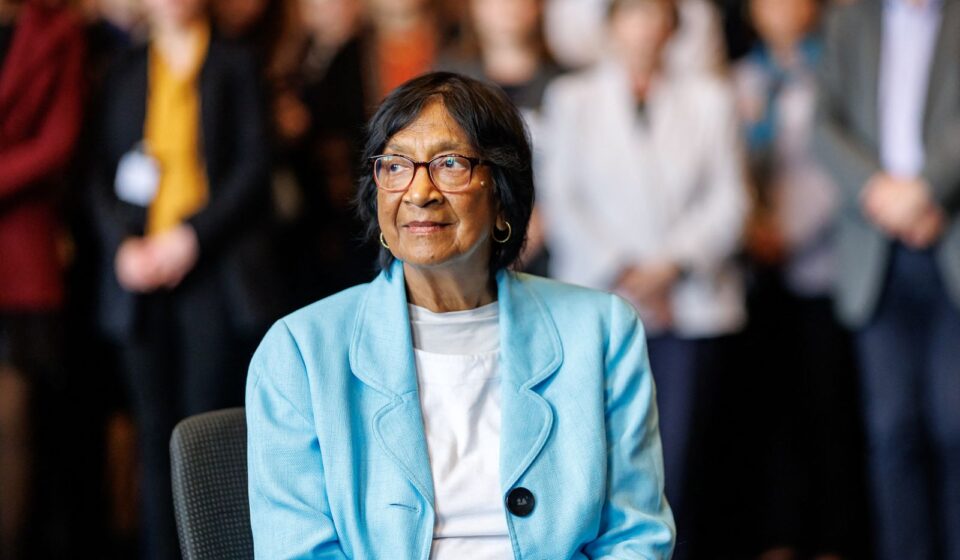

A Nobel Peace Prize meant to celebrate the pursuit of justice has instead reignited a political storm, with South African human rights lawyer Navi Pillay emerging as the 2026 laureate amid growing global divisions over international law, accountability and who deserves recognition for defending peace.
Navanethem “Navi” Pillay, an 85-year-old South African jurist and former United Nations High Commissioner for Human Rights, was awarded the 2026 Nobel Peace Prize for her efforts to promote peace and international law. The Norwegian Nobel Committee recognised her decades long contribution to strengthening international justice and ensuring that perpetrators of war crimes, crimes against humanity and genocide can be held accountable.
Her selection comes at a time when international legal institutions are facing mounting political pressure over their investigations and decisions involving some of the world’s most powerful governments. The award has therefore placed Pillay’s career, and the wider debate over the role of international justice, firmly in the global spotlight.
Born in Durban, South Africa, in 1941 to a family of Indian Tamil origin, Pillay grew up under apartheid, a system of racial segregation and discrimination that denied the majority of South Africa’s population equal rights. Her early experiences of racial injustice helped shape a legal career devoted to challenging discrimination and defending fundamental human rights.
In 1967, she established her own law firm in South Africa’s Natal province, becoming a pioneering figure at a time when racial and gender barriers restricted opportunities for many Black South Africans. Through her legal work, she defended anti-apartheid activists and others who faced persecution under the country’s former racial regime.
Her career later expanded beyond South Africa, placing her at the centre of some of the most consequential international legal proceedings of recent decades. Pillay served as a judge and later president of the International Criminal Tribunal for Rwanda, which prosecuted individuals responsible for crimes committed during the 1994 genocide.
During her work at the tribunal, she contributed to the development of international criminal law, particularly the recognition of sexual violence as a weapon of genocide and a crime against humanity. Her judicial work helped establish that sexual violence committed during armed conflict could constitute one of the gravest international crimes.
Pillay subsequently served as a judge at the International Criminal Court before becoming the United Nations High Commissioner for Human Rights, a position she held from 2008 to 2014. In that role, she worked on international human rights concerns, including discrimination, conflict-related abuses and the protection of vulnerable populations.
She has also played a prominent role in international investigations concerning the Israeli-Palestinian conflict. From 2021 to 2025, she chaired the UN Independent International Commission of Inquiry on the Occupied Palestinian Territory, including East Jerusalem, and Israel. The commission’s findings, including allegations of genocide in Gaza, have attracted strong criticism from Israeli officials, who reject the accusations.
Her work in this area has made her a polarising figure in an already deeply divided international debate. Supporters regard her as a defender of accountability and the principle that no government should be beyond the reach of international law. Critics have questioned aspects of the investigations and accused international bodies of political bias.
The controversy surrounding her work has consequently followed her onto the Nobel stage, illustrating how decisions concerning international justice can become entangled with wider geopolitical disputes.
Nevertheless, the Nobel Committee’s stated reason for awarding Pillay the prize was her contribution to peace and international law, particularly her efforts to strengthen the international legal order and advance accountability for serious crimes. The committee emphasised the importance of institutions capable of addressing violations regardless of the status or influence of those responsible.
The award has also drawn attention to the broader question of whether international courts and human rights institutions can operate independently when their decisions challenge the interests of powerful states. Such institutions depend on cooperation, funding and recognition from governments, yet their credibility also rests on the principle that legal standards should apply consistently.
Pillay’s recognition comes amid tensions surrounding the International Criminal Court and its investigations into alleged international crimes. The court has faced sanctions and criticism from the United States over its actions involving Israeli leaders, highlighting the political consequences that can follow when international legal processes intersect with national interests.
The Nobel Prize does not resolve those disputes, nor does it settle the merits of every case associated with Pillay’s career. Instead, the recognition has renewed attention to the role of international law in addressing atrocities and the challenges faced by those seeking accountability.
For South Africa, Pillay’s achievement adds another name to the country’s distinguished list of Nobel laureates, which includes Nelson Mandela and Archbishop Desmond Tutu, both recognised for their contributions to peace and the struggle against apartheid.
Her journey from practising law under apartheid to serving in senior international judicial and human rights positions reflects the transformation of a career shaped by the pursuit of equality into one with a global impact.
Pillay is expected to receive the Nobel Peace Prize medal and diploma at the formal award ceremony in Oslo on December 10, 2026.
Her selection sends a powerful message about the importance of justice in the pursuit of peace. But it also exposes a persistent international divide: while some view legal accountability as essential to lasting peace, others see international institutions as politically selective when their decisions threaten powerful interests.
Ultimately, the significance of Pillay’s Nobel Peace Prize will extend beyond the recognition of one lawyer’s career. It will also renew scrutiny of whether the international community is prepared to defend the legal principles it celebrates, even when doing so carries political costs.