

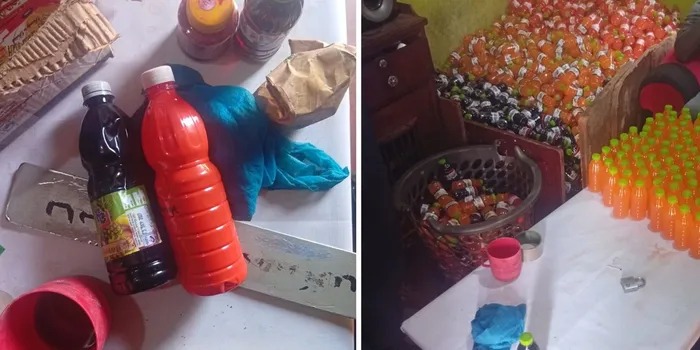

What if the juice in your bottle is not what the label says? That question is now drawing attention after detectives uncovered a suspected counterfeit juice operation running from an ordinary homestead in Muthua, Kabete, Kiambu County, where about 1,400 bottles of suspected counterfeit juice were found ready for circulation.
Two men, Alex Mwaruta and James Munala Inyangala, were arrested after detectives from Kabete Police Station acted on a tip-off from a member of the public. Police said the two were found allegedly producing the suspected counterfeit juice when officers raided the premises.
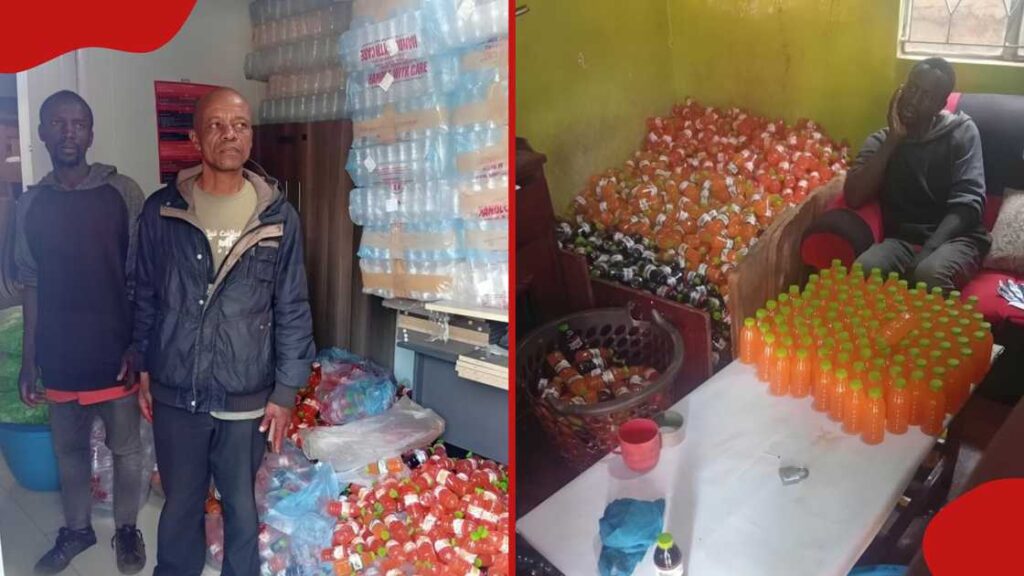
A search of the homestead uncovered approximately 1,400 filled bottles in 200ml and 300ml sizes, alongside 56 cartons of empty bottles and five packets of bottle tops. Detectives also recovered two blue drums and three assorted-colour basins believed to have been used in the operation.
The investigators further seized rubber stamps, ink, office glue and assorted stickers, suggesting that the operation involved not only production but also packaging and branding. An expired certificate purporting to authorise the use of the Standardization Mark for a well-known juice brand was also recovered.
Detectives also found assorted powdery and colourless substances packed in polythene bags in 50-gram portions, as well as in 200ml and 300ml bottles. The exact nature and intended use of the substances had not been established at the time of the arrests. The recovered items were secured as exhibits after the scene was processed by Crime Scene Investigation officers.
The case raises wider concerns because Kenya’s Anti-Counterfeit Authority identifies food products and juices among commonly counterfeited goods, warning that counterfeit food may be produced without proper regard for safety standards and could expose consumers to health risks.
The Kenya Bureau of Standards says the Standardization Mark is mandatory for locally manufactured products, with certification involving inspection of production facilities and testing of product samples before a permit is issued.
The two suspects remain in custody as investigations continue, with authorities expected to establish the source of the materials, intended distribution network and whether the products had already entered the market.