

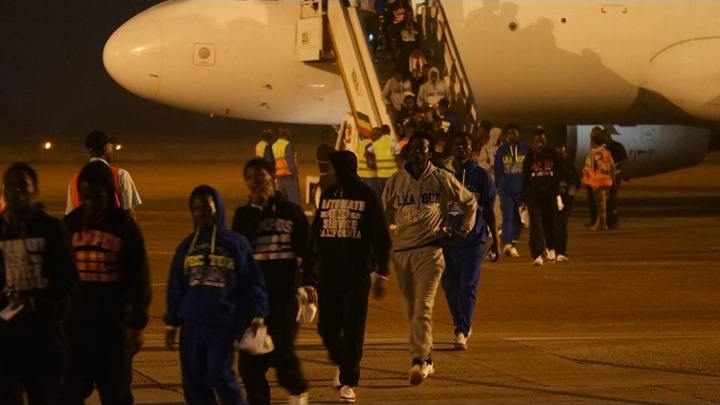

Six migrants deported from the United States were reportedly sent to a fourth country after refusing to leave a plane in Liberia, in what lawyers have described as an unprecedented development under President Donald Trump’s deportation programme.
The six four Cubans, one Brazilian and one Cameroonian were among about 20 people flown from the US to Liberia on August 20. The deportees were reportedly shackled at their wrists, waists and ankles during the journey.
After landing in Monrovia, the capital of Liberia, the six refused to disembark. According to their lawyers, some were allegedly assaulted by US Immigration and Customs Enforcement (ICE) officers before being returned to the aircraft.
The deportees were reportedly told they would be taken back to the United States. Instead, several hours later, the plane landed in Equatorial Guinea, where the six were taken by armed guards to a former luxury hotel being used as a detention facility in the capital, Malabo.
Meredyth Yoon, litigation director at Asian Americans Advancing Justice-Atlanta, said she had never heard of deportees refusing to leave one third country before being sent to a fourth country on the same flight.
The development has raised concerns over the treatment and legal rights of migrants being deported to countries other than their own. Lawyers representing the group said the deportees did not agree to, or were not informed about, their transfer to Liberia or Equatorial Guinea.
Equatorial Guinea has reportedly received dozens of deportees from the US since November, making it the largest recipient of US third-country deportees in Africa. The country is governed by President Teodoro Obiang Nguema Mbasogo, who has been in power for nearly five decades.
The deportation arrangement was reportedly secured by Vice-President Teodoro Nguema Obiang Mangue, known as Teodorín, the president’s son. The US government is expected to pay Equatorial Guinea $7.5 million under the agreement, which allows for the transfer of deportees to the country.
Human rights advocates have criticised the conditions in which deportees are being held. Tutu Alicante, head of the US-based organisation EG Justice, described the conditions at the detention facility as inhumane, alleging that some detainees have been deprived of food and water for long periods.
One of the Cuban deportees reportedly told The Guardian that the group was desperate to draw attention to their situation. However, communication was later cut off after guards allegedly confiscated their phones to prevent them from speaking to the media.
Another detainee, who reportedly suffers from a large abdominal hernia, allegedly required urgent surgery. He said he was denied treatment at a hospital in Malabo because he lacked the necessary documents, further intensifying concerns about the welfare of those being held in Equatorial Guinea.