
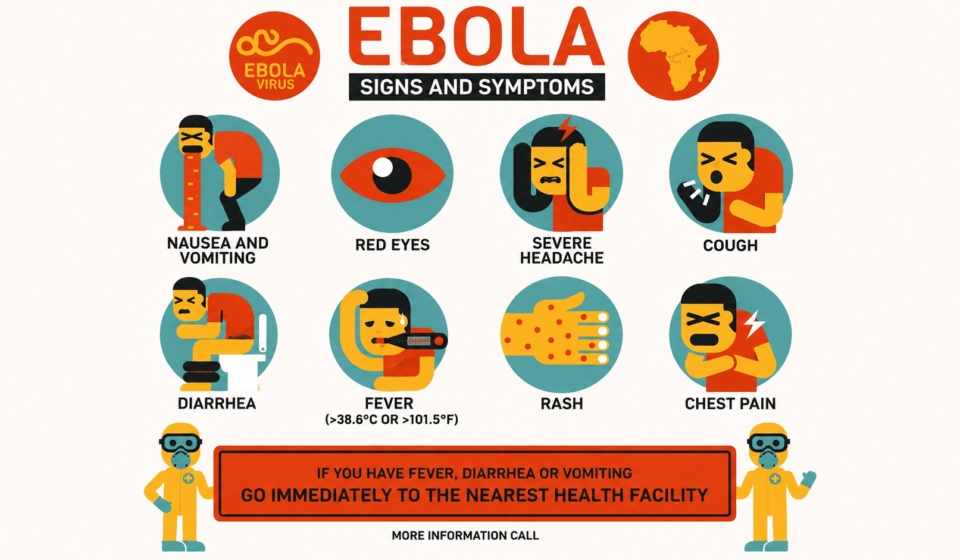

The World Health Organization (WHO) has warned that it is struggling to keep pace with the latest Ebola outbreak in the Democratic Republic of Congo (DRC), saying the virus had been spreading for at least three months before the outbreak was officially declared.
The outbreak, caused by the Bundibugyo strain of Ebola, was declared on May 15. Since then, more than 1,900 people have died, making it the second-deadliest Ebola outbreak on record after the 2014–2016 West Africa epidemic.
WHO Africa Director Dr. Mohamed Janabi said health authorities are racing to contain the disease but remain behind its spread.
“We are chasing the virus; the virus is ahead of us,” Dr. Janabi said during a news conference in Bunia, the epicentre of the outbreak.
Research by the WHO indicates the virus began circulating in February but was initially misdiagnosed as malaria or typhoid, allowing it to spread undetected.
Health officials say insecurity in eastern DRC has severely hampered response efforts, with aid workers able to reach only about 30% of infected patients, while many others die at home.
The response has also been complicated by traditional burial practices, which involve touching the bodies of the deceased, and mistrust of health authorities in some affected communities.
Unlike other Ebola strains, there is currently no approved vaccine or recognised treatment for the Bundibugyo variant, making containment efforts more challenging.
Despite these setbacks, the WHO says dedicated treatment centres have been established in eastern DRC, helping speed up diagnosis and patient care.
According to the DRC Ministry of Health, the country has recorded 4,294 confirmed Ebola cases and 1,960 deaths since the outbreak was declared.
The deadliest Ebola outbreak remains the 2014–2016 West Africa epidemic, which claimed 11,325 lives.