


Electricity consumption in Kenya increased across all customer categories in the year ended June 2026, with domestic consumers recording an 18.87 percent rise while large commercial and industrial users remained the biggest consumers of power, according to the latest Energy and Petroleum Regulatory Authority (EPRA) statistics.
EPRA’s 2026 report covers the performance of the electricity, petroleum and renewable energy subsectors for the financial year ended June 30, 2026.Domestic electricity consumption increased by 686.75 gigawatt-hours (GWh), rising from 3,640.32 GWh in the year ended June 2025 to 4,327.07 GWh in June 2026.
EPRA attributed the increase to higher per capita electricity consumption and growth in the number of domestic customers.Domestic users accounted for 34.77 percent of total electricity consumption, up from 32.13 percent a year earlier.
Large commercial and industrial consumers, however, continued to account for the largest share of electricity consumption at 47.57 percent.
Their consumption increased by 5.33 percent from 5,620.71 GWh to 5,920.06 GWh during the period.Despite the increase in actual consumption, the category’s share of total electricity use fell from 49.61 percent to 47.57 percent.
EPRA attributed the decline to stronger growth in consumption among other customer categories.
Small commercial consumers, which comprise micro, small and medium enterprises, recorded a 5.17 percent increase in electricity consumption from 1,913.26 GWh to 2,012.17 GWh.
Their share of total electricity consumption declined from 16.89 percent to 16.17 percent, with EPRA linking the reduction to stronger growth in domestic and electric mobility consumption.EPRA reported that total electricity generation rose by 8.44 percent to 15,692.81 GWh during the year, while peak demand reached 2,514.28 megawatts on June 29, 2026, an 8.55 percent increase from the previous year.
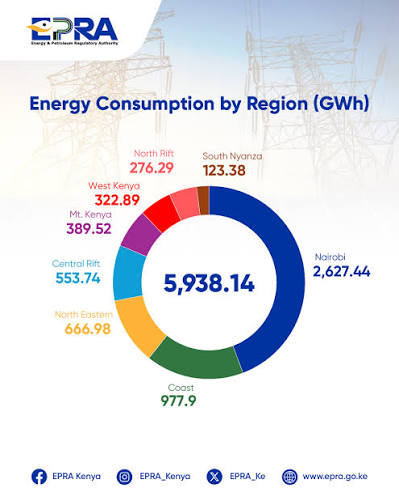
The regional figure was attributed by EPRA to the area’s large population and concentration of industrial activity. Consumption in the Nairobi region increased by 10.09 percent from 4,964.34 GWh recorded in the previous year.