

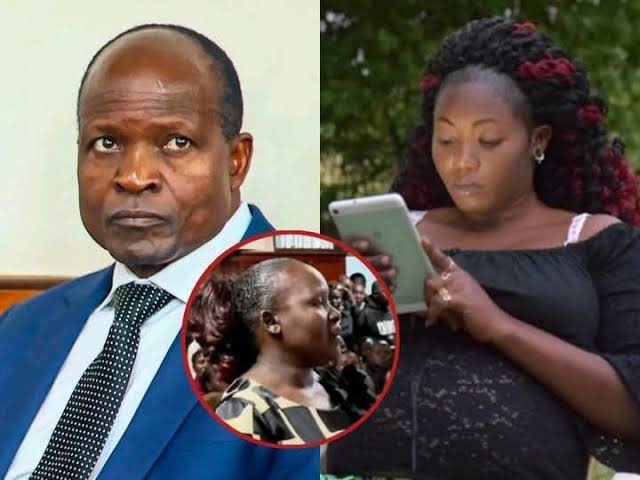

Eight years after Sharon Otieno was abducted, sexually assaulted and brutally murdered while 28 weeks pregnant, the case has taken an unexpected turn , her parents are now asking the court to spare the man convicted of killing her, as questions over reconciliation, financial support and justice take centre stage.
The parents of slain journalism student of Rongo University Sharon Otieno have asked the High Court to give former Migori Governor Okoth Obado a non-custodial sentence, saying they have forgiven him and are seeking reconciliation between the two families.
The plea came during Wednesday’s sentencing proceedings before Justice Cecilia Githua, weeks after Obado, his former personal assistant Michael Oyamo and former Migori County official Caspal Obiero were convicted of Sharon’s murder. The court found that the prosecution had proved the case against the three beyond reasonable doubt.
Sharon, 26, was killed in September 2018 after being abducted alongside a journalist who managed to escape. Her body was later discovered in the Owade area of Homa Bay County. She was 28 weeks pregnant, and the court heard evidence that she had been sexually assaulted and stabbed.
Obado admitted during the trial that he had been romantically involved with Sharon and that he was the father of her unborn child. He, however, denied involvement in her murder.
According to evidence considered by the High Court, Sharon’s pregnancy and her relationship with the then,Migori governor became central to the events preceding her death. The prosecution argued that Obado wanted to prevent details of the affair and pregnancy from becoming public.
In its July 2026 judgment, the High Court found that Obado had a motive to silence Sharon and concluded that he, Oyamo and Obiero acted together with others who were not before the court in the killing.
The court also rejected Obado’s claim that he had comfortably accepted Sharon’s pregnancy. Evidence presented during the trial included testimony that Sharon had been urged to terminate the pregnancy and that Obado allegedly gave her KSh30,000 for an abortion.
The latest development has surprised many observers because Sharon’s parents had previously said after the conviction that they had forgiven those responsible while allowing the law to take its course.
But ahead of sentencing, the family entered reconciliation discussions with representatives of Obado’s family. According to reports on the probation process, the reconciliation included discussions about commitments Obado had made to Sharon and support for her surviving children.
Sharon’s parents have also told the court that Obado voluntarily supported the family financially after Sharon’s death. Her mother, Melida Auma, argued that sending Obado to prison could amount to the family losing another source of support.
The family has separately sought about KSh4.7 million in compensation, citing approximately KSh3.5 million spent on Sharon’s funeral and burial and KSh1.2 million on travel, accommodation and meals associated with the lengthy court proceedings. The family says it was forced to sell land and a cow to meet some of these costs.
That financial request, however, should not be presented as proof that Sharon’s mother wants money instead of justice. The documented position is that the family is seeking compensation for expenses and support for Sharon’s children while simultaneously asking for reconciliation and a non-custodial sentence for Obado.
The prosecution has opposed a non-custodial sentence, arguing that the circumstances of Sharon’s killing warrant the maximum punishment available under the law. It has asked the court to consider a death sentence for Obado, Oyamo and Obiero.
The State has also maintained that while Sharon’s parents are entitled to forgive Obado, their position cannot determine the sentence because the murder is a criminal offence against the State and society.
The High Court has now postponed sentencing to November 27, 2026, when Justice Githua is expected to determine the punishment for the three convicted men.
The case has therefore entered a striking new phase, a family seeking reconciliation and financial relief, a prosecution demanding punishment, and a court left to decide how forgiveness, compensation, the circumstances of the murder and the law should factor into sentencing.