

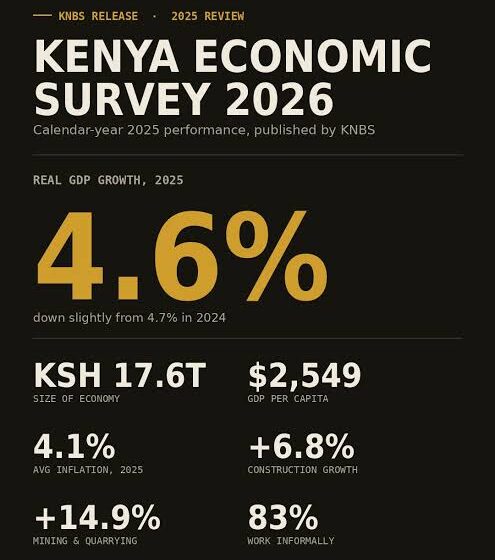

Kenya’s economy is projected to grow by 4.6 percent in 2026, with the World Bank warning that rising energy costs, fiscal pressures and unpredictable weather could undermine the recovery and constrain growth over the medium term.The projection, contained in the lender’s November 2026 Kenya Economic Update, represents an upward revision of 0.3 percentage points from its July forecast, following stronger-than-expected economic performance in the first half of the year.
The economy expanded by 5.2 percent in the first half of 2026, compared to 4.9 percent in a similar period last year, supported by stronger industrial and services activity.
However, the World Bank projects growth to moderate to 4.4 percent in 2027 before recovering to 4.8 percent in 2028, remaining below the country’s potential.
The lender attributed the risks to disruptions in global energy markets following the conflict in the Middle East, which have increased fuel and transportation costs, alongside the possibility of erratic El Niño rainfall towards the end of the year.Household consumption, which accounts for nearly three-quarters of Kenya’s Gross Domestic Product (GDP), is expected to slow from 4.7 percent in 2025 to 4.1 percent in 2026 as higher energy and transport costs erode purchasing power.
Inflation has also accelerated, rising to 7.3 percent in October from 4.6 percent a year earlier, largely driven by energy and food prices.
The outlook is further complicated by fiscal vulnerabilities, with the budget deficit widening to 6.8 percent of GDP in the 2025/26 financial year against an initial target of 4.7 percent. Public debt stood at 69.9 percent of GDP at the end of June 2026.
Private investment is expected to provide support, with private sector credit growth reaching 10.6 percent in September 2026, up from 5 percent a year earlier. Foreign direct investment inflows also increased by 170.5 percent to a record USD 2.74 billion in the 12 months to September.