

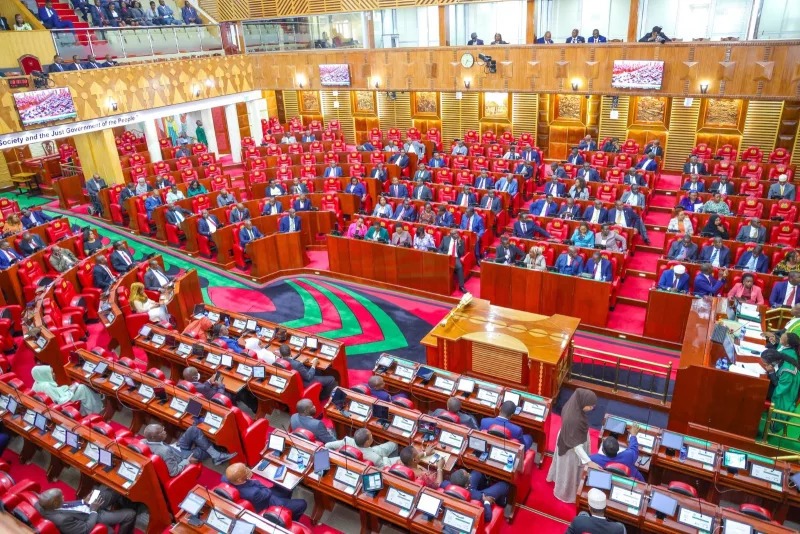

With the 2027 General Election approaching, claims that Parliament has removed the requirement for the electoral commission to livestream election results have sparked public concern over electoral transparency. However, subsequent official clarifications indicate that the livestreaming requirement was retained, exposing the need for Kenyans to distinguish between proposed amendments and the final decisions made by lawmakers.
The National Assembly has passed the Elections (Amendment) (No. 2) Bill, 2024, introducing proposed changes to Kenya’s electoral framework ahead of the 2027 General Election.
The Bill, which has attracted public attention over its potential implications for election management, addresses several areas, including voter registration, political party nominations, the recall of Members of Parliament and the handling of electoral disputes.
One of the most contentious issues surrounding the legislation has been whether it removes the legal requirement for the Independent Electoral and Boundaries Commission (IEBC) to establish a mechanism for livestreaming election results announced at polling stations.
An image circulating on social media claims that MPs passed the Bill, removing that requirement.
However, that claim does not accurately reflect the version passed by the National Assembly. According to subsequent clarifications from Parliament and the State Department for Parliamentary Affairs, lawmakers deleted the clause that sought to amend Section 39 of the Elections Act, thereby retaining the existing livestreaming requirement.
Section 39 of the Elections Act provides the legal framework governing the determination, announcement and transmission of election results.
The existing provisions require the IEBC to establish a mechanism for livestreaming results as announced at polling stations, with the streamed results intended for public information.
The law also provides for the electronic transmission and publication of election results, alongside the physical records used in the electoral process.
These safeguards are significant because transparency in the announcement and verification of results is central to public confidence in elections.
Livestreaming allows members of the public to follow the announcement of results, while the publication and transmission of polling station results provide additional avenues for scrutiny and verification.
The requirement does not mean that livestreamed figures alone determine the official presidential election outcome. The formal declaration of presidential results remains subject to the constitutional procedures governing the electoral process.
The controversy emerged as Parliament considered amendments intended to revise different aspects of the Elections Act ahead of the next General Election.
The Senate had considered changes to Section 39, prompting concerns about the future of the livestreaming requirement.
However, after the Bill was considered by the National Assembly, lawmakers removed the clause proposing changes to that section.
State Department for Parliamentary Affairs Principal Secretary Aurelia Rono publicly clarified that the livestreaming requirement had been retained.
The clarification followed public debate over reports suggesting that MPs had abolished the requirement.
The development highlights the importance of examining the actual provisions passed by Parliament rather than relying solely on headlines or summaries circulating on social media.
Beyond the livestreaming controversy, the Elections (Amendment) (No. 2) Bill, 2024, proposes changes affecting several aspects of electoral administration.
These include provisions on access to the voters’ register, political party nominations, the procedure for recalling elected MPs and the handling of electoral disputes.
The proposals also seek to clarify aspects of voter registration during by-elections and revise provisions concerning the IEBC’s role in political party primaries.
The changes form part of broader efforts to review Kenya’s electoral framework before the 2027 elections.
However, the Bill’s passage by the National Assembly does not, by itself, complete the legislative process. Following the amendments made by the National Assembly, the Bill is to return to the Senate for consideration in accordance with Article 110(4) of the Constitution.
The next stages of that process will determine the final form of the legislation.
The dispute over livestreaming highlights the importance of electoral transparency as Kenya prepares for another General Election.
For voters, access to election information helps them follow the process and assess the credibility of results announced by electoral officials.
Although the livestreaming requirement has been retained in the version passed by the National Assembly, the broader debate demonstrates how changes to electoral laws can generate public anxiety when information is incomplete or inaccurate.
As the legislative process continues, Kenyans will need to follow official parliamentary updates to establish which amendments ultimately become law.