

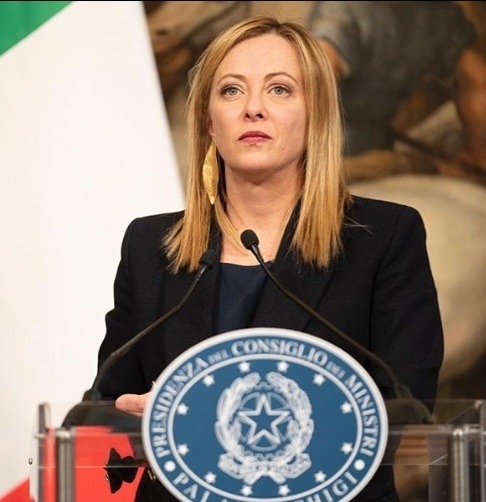

Italy’s conservative government has approved new school rules banning face-covering Islamic veils, including burqas and niqabs, while also limiting the number of pupils with poor Italian-language skills in individual classrooms.
Prime Minister Giorgia Meloni said the measures are intended to promote integration and prevent the creation of what she described as “ghetto classes.” She argued that the new rules would help ensure students have equal opportunities regardless of their background.
Under the decree, face coverings such as burqas and niqabs will no longer be permitted in schools, although the hijab will remain allowed. Education Minister Giuseppe Valditara said the face-covering rule is expected to affect about 1,000 classrooms, representing roughly 0.3 percent of classrooms across Italy.
The decree will also introduce limits on the number of students with limited Italian-language proficiency in classrooms. Official figures show that pupils without Italian citizenship accounted for 11.2 percent of Italy’s school population between 2022 and 2023, while classes where foreign students made up more than 30 percent represented 7.6 percent of the total.
The measures have faced strong criticism from opposition parties and child-rights groups. Critics fear the rules could force some pupils to attend schools outside their local communities and could create difficulties in areas with large migrant populations.
Save the Children warned that the policy could have discriminatory effects, while opposition leader Elly Schlein accused the government of launching what she called a “new witch hunt” at the expense of children. The decree has taken effect but must receive parliamentary approval within 60 days, with Meloni’s governing coalition holding a majority in parliament.