

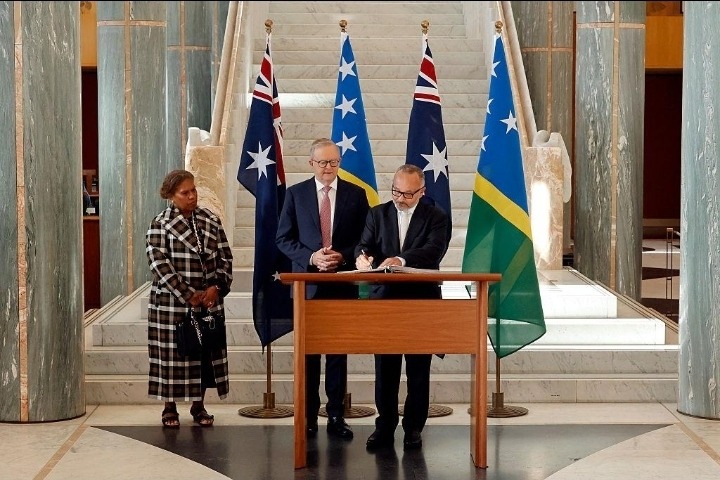

Australia and Solomon Islands have reached an in-principle agreement on a landmark new treaty, as Canberra seeks to strengthen its relationship with the Pacific nation amid growing regional competition. The proposed deal includes a significant increase in Australian financial support, with a leaked message revealing plans for more than $980 million in additional funding.
The Australian government is reportedly keen to have the treaty signed in the coming weeks, following political uncertainty in Solomon Islands. Prime Minister Matthew Wale recently survived a leadership challenge after Home Affairs Minister Manasseh Maelanga withdrew a motion of no confidence against him.
The political dispute had raised concerns in Canberra that a change of leadership could threaten the progress of the treaty. Wale, who became prime minister in May, has moved closer to Australia and the United States while expressing concerns about China’s growing security and political influence in Solomon Islands.
Under the proposed arrangements, Australia would also increase funding for a scheme that provides money directly to members of parliament for development projects in their constituencies. A leaked message indicated that each of the country’s 50 constituencies could receive SI$5 million before the end of this year, followed by additional funding in 2027 and 2028.
The funding has attracted attention because the constituency programme has sometimes been controversial, with concerns over how money provided directly to MPs is allocated and spent. However, Australian officials have defended the discussions, saying the funding is intended to support development priorities rather than influence Solomon Islands’ domestic politics.
The leaked message also highlighted Australia’s concern about the political uncertainty surrounding Wale’s government. It urged both countries to maintain momentum and finalise the treaty before Solomon Islands’ November budget session, when political developments could once again affect the agreement.
Wale ultimately thanked MPs who remained loyal to his government and those who later joined his side. He also praised Maelanga for withdrawing the no-confidence motion, saying the move would help reduce political tensions and give his government an opportunity to deliver on its plans.
The developments are being closely watched by Australia, which sees Solomon Islands as strategically important in the Pacific. Canberra’s efforts to strengthen ties with Honiara come as China continues to expand its diplomatic, economic and security relationships across the region.
The proposed treaty therefore represents more than a financial agreement, with both countries seeking to deepen cooperation on development, security and regional interests. Australia’s push to complete the deal while Wale remains in office reflects its desire to secure a long-term partnership with Solomon Islands despite the country’s unpredictable political environment.